
Controlling Superintelligence Is Impossible: We Must Prohibit It.
The next UK government should tackle the extinction risk of superintelligence, prohibiting its development domestically, and working with the US and others to prevent it globally.

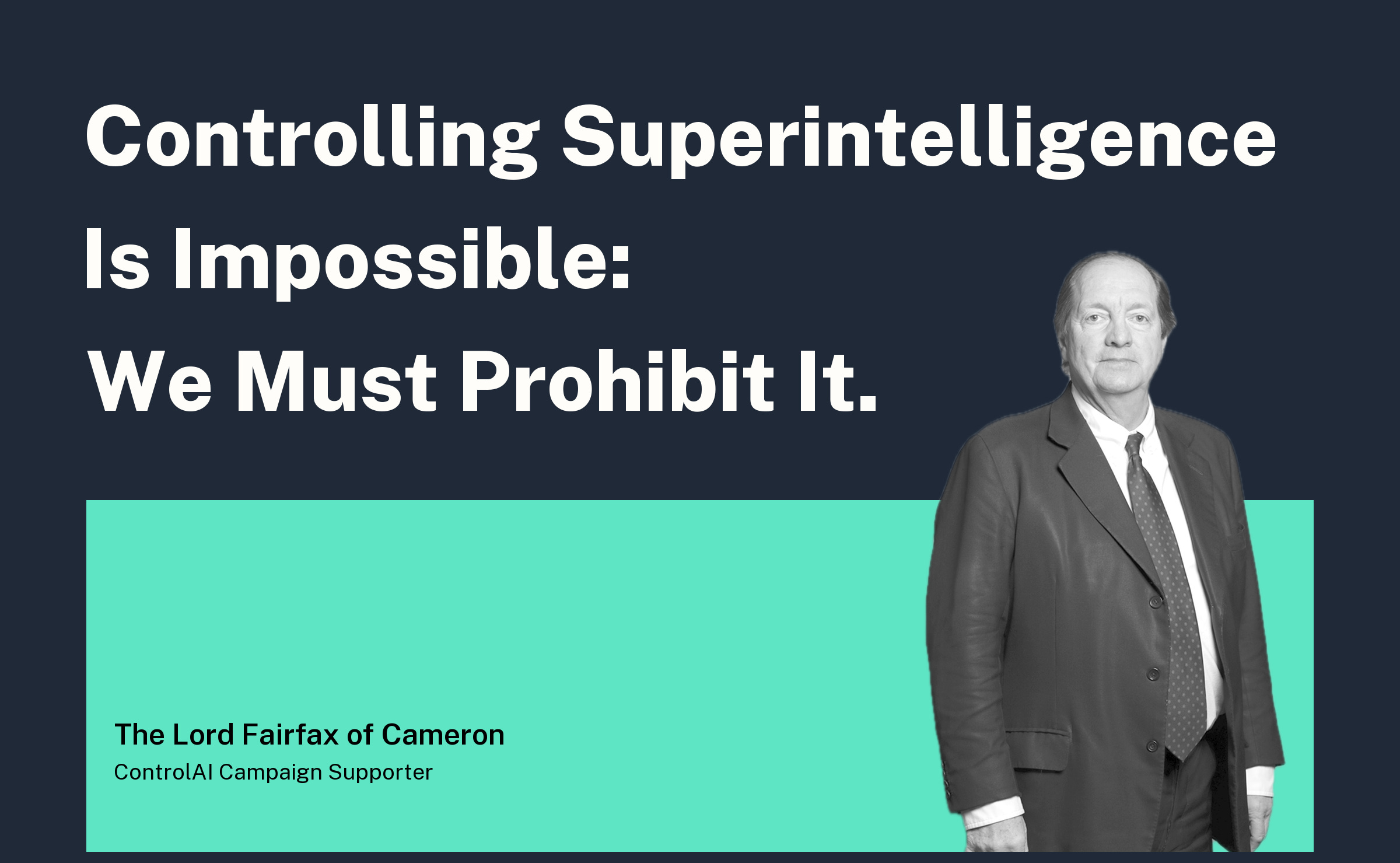
Author: Nicholas Fairfax, Lord Fairfax of Cameron
For over thirty years, I served in the United Kingdom’s House of Lords, an institution known for its composure rather than alarm. After retiring from Parliament in April, I thought I would spend my time on quieter matters. Instead, I remain focused on the gravest extinction threat facing humanity, that of superintelligent AI, and what our government can do to prevent this threat.
As I write, the leading AI companies are racing as fast as possible to develop superintelligent AI. Superintelligent AI is AI that is vastly smarter than humans and capable of escaping human control and overpowering national security institutions. Nobel Prize winners, leading AI scientists, and the CEOs of AI companies themselves have warned that superintelligence would pose a realistic extinction risk to humanity. When I led a House of Lords debate on the risk from superintelligence earlier this year, I highlighted experts’ assessments that we may have just a few years left to prevent the threat.
But while private companies seek to build this uncontrollable force, governments thus far have been solely looking at the risks of today, rather than what’s just around the corner: fully autonomous, enormously capable systems that humanity cannot control.
Instead of going gentle into that good night, governments around the world need to wake up to the unprecedented threats at play and take urgent action to prohibit superintelligence, while we still can.
The warning signs have been blinking red for a while now as AI capabilities grow at an exponential rate. In late 2025, Britain’s MI5 intelligence agency warned that we must scope out the risks from “non-human, autonomous AI systems which may evade human oversight and control”. Just months ago, the leading AI company Anthropic initially held back its model Mythos because it demonstrated nation-state level cyberattack capabilities. The director of the US National Security Agency and Pentagon’s Cyber Command later confirmed that Mythos broke into almost all of his organization’s classified systems within hours. And more recently still, the US government ordered OpenAI to limit the release of its most advanced model to a select group of organizations.
Today’s AI models already demonstrate unprecedented cyberweapon capabilities, but we must keep in mind that these are the least capable AIs we’ll ever have. Because AI systems are grown from data rather than coded line-by-line like traditional software, we have no way to reliably predict their actions and control them. This problem is increasingly dangerous as we reach more powerful AI systems that can autonomously do things in the real world, particularly when coupled with advanced robotics.
The CEOs of the leading AI companies fully understand the risks of the technology they are developing. OpenAI’s Sam Altman has said repeatedly that superintelligence is “probably the greatest threat to the continued existence of humanity”. Elon Musk has said that there is a 20% chance of human “annihilation” by advanced AI.
If, like me, you believe that any chance of human extinction higher than zero is too high, the pursuit of superintelligent AI is unacceptable. That is why I joined public figures including Sir Stephen Fry, former US National Security Advisor Susan Rice, former advisor to President Trump Steve Bannon, and AI experts like the ‘godfathers of AI’ Geoffrey Hinton and Yoshua Bengio, in signing a statement calling to prohibit superintelligent AI. But statements on their own are not enough in the face of this urgent threat.
Governments have the power to intervene when they understand that the risks are too large to ignore, and they must do so now. But hastily enforced retroactive measures will not be able to contain superintelligent AI. The minute that superintelligence is developed, we will already have lost the battle. Because there will be no way to ‘unplug’ a superintelligent system, the only logical response is to ensure it is never developed in the first place.
It is time for states to take responsibility for preventing this threat, instead of idly standing by while the AI companies push us to the brink. Britain has acted before to bring countries together on advanced AI risks during the world’s first AI Safety Summit at Bletchley Park. As we prepare for a leadership change when UK Prime Minister Keir Starmer leaves office, I see a vital opportunity for the incoming UK government to tackle the risk of superintelligence head-on.
The UK government should immediately recognise that superintelligence poses an extinction risk to humanity and then act to prevent the development of superintelligence on UK soil. This should be followed by the UK working with the US and international partners to champion an international agreement to prohibit superintelligence globally.
The political momentum behind such policies is continually growing, evidenced by over 120 UK lawmakers backing ControlAI’s campaign acknowledging the extinction risk from AI and recognising superintelligence as a national and global security threat. Provided it wakes up to the enormity of the risk, Britain can reclaim our position as the global AI governance leader. A catastrophic ending is not inevitable, but time to secure our future is running out.
Nicholas Fairfax, Lord Fairfax of Cameron, is a Conservative former Peer who served in the House of Lords between 1977–1999 and 2015–2026. He co-edited The Artificial Intelligence Revolution: Challenges and Opportunities, published by Springer Nature in May 2026. He was also a member of the House of Lords Select Committee on AI in Weapons Systems that worked and reported in 2023.
The problem is the ones who are developing this horrible thing are the US Oligarchs. And, to them, the first person to create a Super Intelligence becomes a God. And all of them want to be a God. Except the person who makes the Super Intelligence won’t be a God. The Super Intelligence will be a God.
We must look for answers to these issues NOW!