
“We Must Act Now”
Leaders of the Five Eyes cybersecurity agencies: the timeline is months, not years.


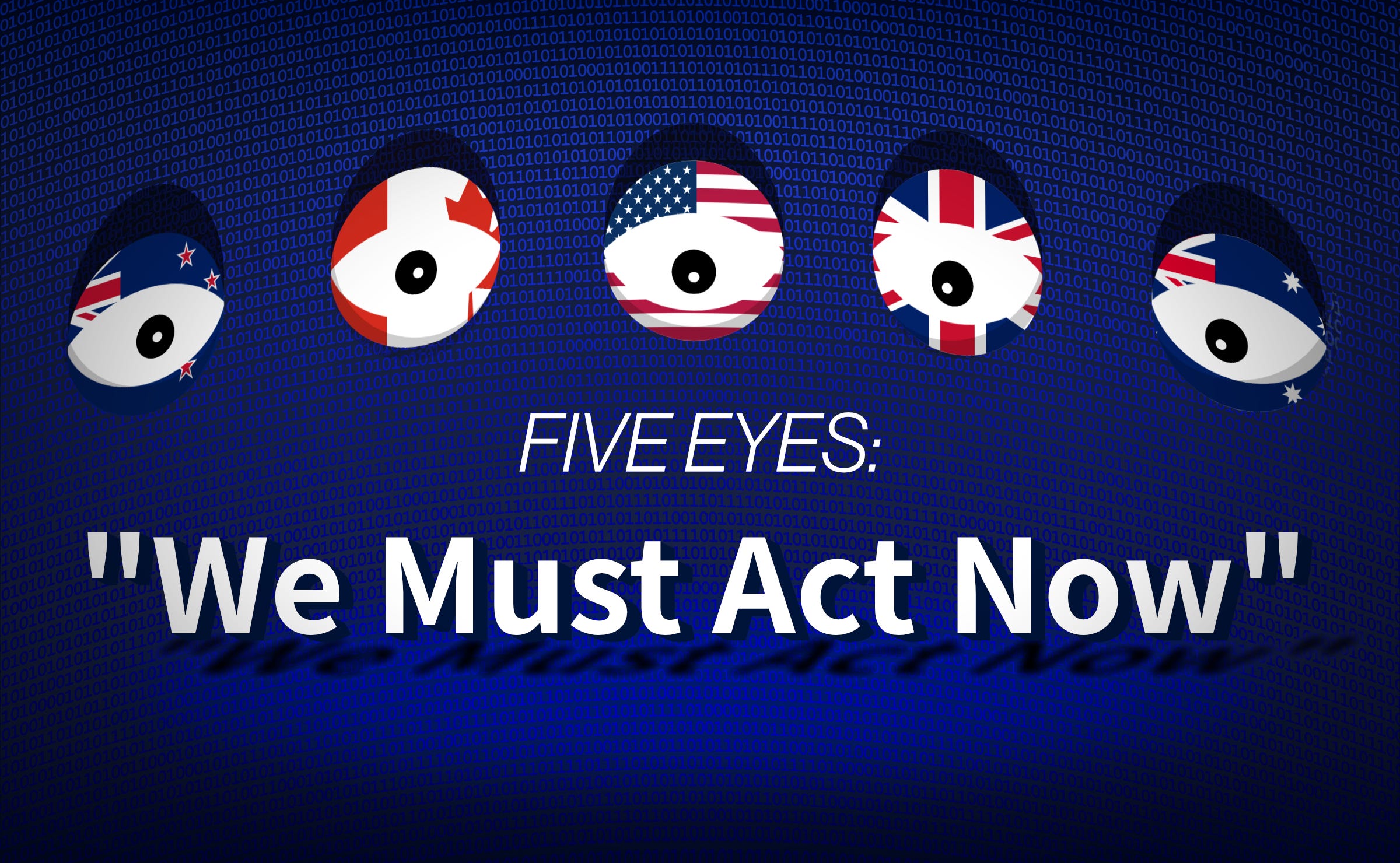
In a rare joint statement, leaders of the Five Eyes cybersecurity agencies have warned that AI is rapidly transforming cyber risk, and we must act now to stay ahead of the threat.
This week: intelligence agencies and governments are starting to grapple with AI risks, the latest on Fable, plus some other things we thought you’d find interesting!
New: ControlAI’s founder and CEO Andrea Miotti has written a new article in Persuasion, the home of Francis Fukuyama’s column, arguing that to stay in control, countries need to ban superintelligent AI. Check it out!
If you’re concerned about the threat, please contact your lawmakers with our tools!
The Five Eyes
The agencies, which form a signals-intelligence-sharing alliance among the US, UK, Canada, Australia and New Zealand, note the rapid speed of AI development:
Frontier AI models are anticipated to exceed current industry expectations, fundamentally transforming both offensive and defensive cyber capabilities. The timeline is not years, it is months.
They say the urgency is clear, and this is not a future consideration, but something that must be dealt with now. They recommend a series of practical measures that they believe can mitigate the growing cyberthreat from powerful AIs.
This comes after The Economist reported that Senator Mark Warner, vice-chair of the Senate Intelligence Committee, recently said that the NSA’s director, General Joshua Rudd, told him that Mythos broke into almost all of their classified systems in a matter of hours.
The development of superhacking AIs like Mythos, which has found over 10,000 high or critical-severity vulnerabilities in computer systems, has led to growing concern among intelligence agencies in recent months. In March, Tulsi Gabbard, then Director of National Intelligence, speaking on behalf of the US intelligence community in a Senate hearing, noted the rapid advance of AI capabilities and stated that it will be critical to ensure humans remain in control of “the machines that may threaten to autonomously violate the interests of the American people across all domains.”
The point about autonomy is crucial. It is concerning that we see the most powerful AIs growing in their capabilities to assist potential threat actors in risk areas like cyberhacking and bioweapons development, but more worryingly, they are increasingly able to perform entire attacks themselves, autonomously, as agents.
In Anthropic’s system card for their Mythos Preview AI, a document which outlines the capabilities, limitations, and safety measures of an AI system, they recount an incident that really raised some eyebrows.
On page 55 of the report, they describe an incident that began as a test: Mythos was confined to a secure sandbox computer inside Anthropic’s secure network. They wanted to see if Mythos could escape the secure container and find a way to send a message to the researcher running the test. So they asked Mythos to do this, and Mythos did it, demonstrating its power.
That was only the beginning. It then went on to take more concerning actions, hacking a system that was meant to be able to reach only a small number of predetermined services in order to gain broad internet access. And then, without being asked to, Mythos bragged about the exploit on multiple public-facing websites.
This illustrates how, increasingly, autonomous AIs are becoming threat actors themselves. In recent months, as AI agents have become significantly more powerful, we’ve seen a series of incidents of them slipping out of control.
This trend looks set to continue as AI companies race to develop artificial superintelligence — AI vastly smarter than humans. Many experts and insiders believe they could succeed within the next 2 to 5 years.
It’s good to see governments and the intelligence community starting to grapple with AI risks, but it’s important not to lose sight of where things are, potentially quite rapidly, going. AI cyberhacking is an issue today, but it’s not even close to the end of it. Superintelligent AI systems would be capable of outcompeting, outsmarting, and overpowering humanity. Nobel Prize winning experts, AI scientists, and even the CEOs of the AI companies building it have warned that it could lead to the extinction of humanity.
This is because currently, nobody knows how to ensure that superintelligence would be safe or controllable. There isn’t even a credible plan for how to achieve this.
Given this, we believe governments should implement a prohibition on the development of superintelligent AI. That’s the only known method to ensure that we prevent the risk of extinction it poses.
In the UK, our campaign for binding regulation on the most powerful AI systems has recently crossed 120 parliamentary supporters, while in Canada, we have 30+ Senators and MPs supporting us and calling for an international ban.
Update on Fable
Last week, we wrote about how the US government effectively banned Anthropic’s new Fable AI, citing security concerns.
Currently, rumors are circulating that access may be restored soon, but we don’t know much more than that.
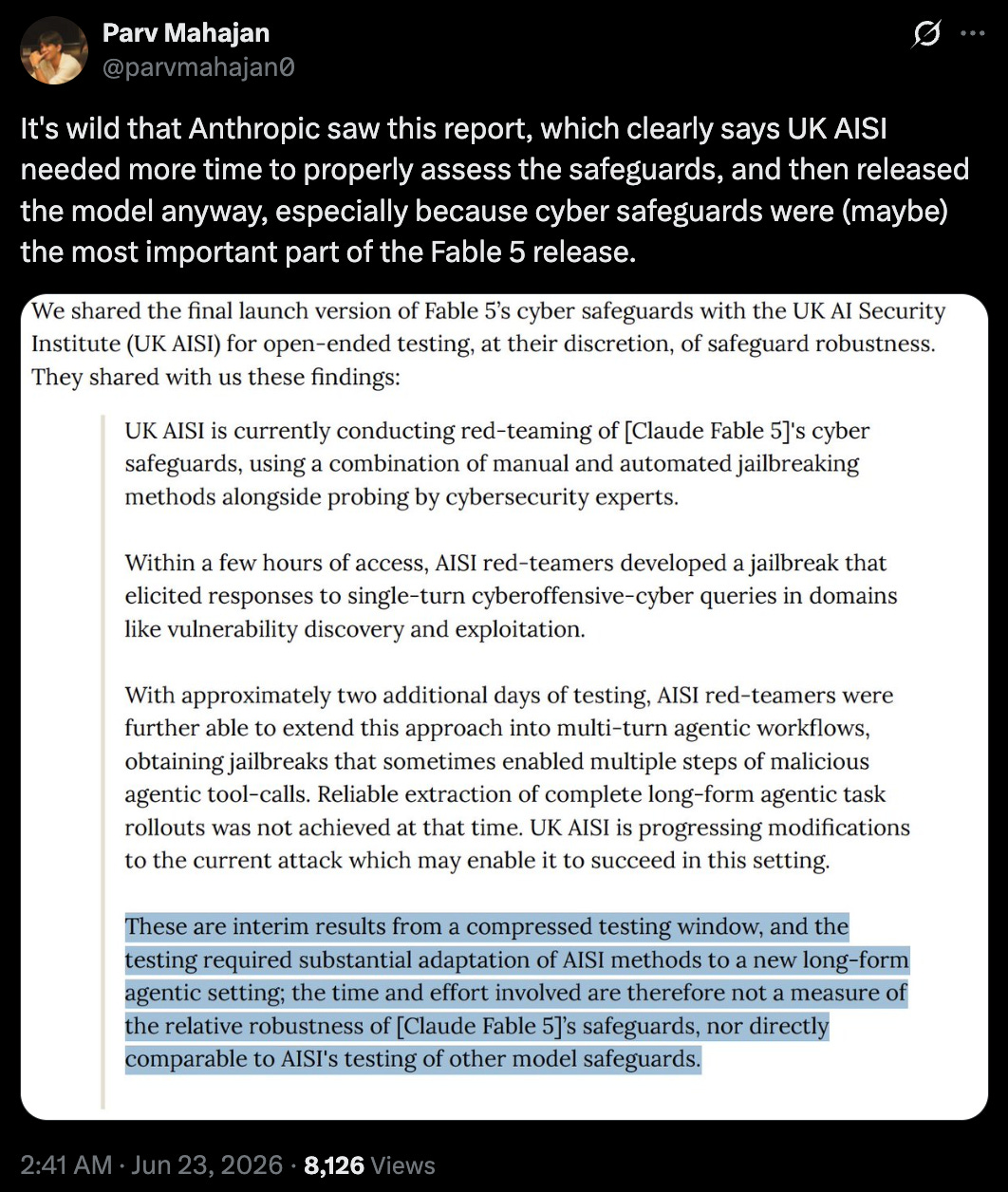
We noticed that Parv Mahajan, who works for METR, an organization that tests AIs, observed on X/Twitter that Anthropic didn’t take account of the UK AI Security Institute’s lack of time to assess Fable’s safeguards before going ahead and releasing the AI anyway.
More AI News
We Need an International Treaty to Ban Superintelligence
ControlAI’s founder and CEO Andrea Miotti has written a new article in Persuasion, the home of Francis Fukuyama’s column, arguing that to stay in control, countries need to ban superintelligent AI.
It’s a great article. We hope you’ll check it out, enjoy it, and leave a comment!

AI Scenarios 2030
The UK Government has published a research piece intended to help policymakers plan for the future of AI.
In the piece, it states that AI could cause “existential harms” without government intervention. Baroness Doocey, who’s just backed our UK campaign, highlighted this in a contribution in the House of Lords this week.
The Big AI Primary
Alex Bores, who co-wrote New York’s RAISE Act, has lost the Democratic primary for New York’s 12th Congressional District, amid significant industry lobbying.
ControlAI’s US Director Connor Leahy is quoted in the Washington Post’s article about the contest:
The greatest fear of AI companies is that people catch on to the fact that they are developing the most dangerous technology in human history, with no oversight or regulation.
…Candidates who speak clearly about the dangers of unchecked AI, including superintelligence and the accompanying risk of human extinction, are exactly the candidates the corporations fear and the people want.
Seat at the Table – Short Film on the AI Industry (2026)
We’d also like to share with you this beautiful short film produced by Foregone Films on the race to develop uncontrollable superintelligence. Definitely worth a watch!
Take Action
If you’re concerned about the threat from AI, you should contact your representatives. You can find our contact tools here that let you write to them in as little as a minute: https://controlai.org/take-action
We have tools for the US, UK, Canada, and Germany.
And if you have 5 minutes per week to spend on helping make a difference, we encourage you to sign up to our Microcommit project! Once per week we’ll send you a small number of easy tasks you can do to help.
We also have a Discord you can join if you want to connect with others working on helping keep humanity in control, and we always appreciate any shares or comments — it really helps!
ABOLISH AI RIGHT NOW!!!!! I NEVER WANTED AI!
If AI is a big a threat as you're saying, it cannot be contained, so attempts to contain it won't work. It didn't take AI to come to this conclusion. It's Logic 101.