
Can Governments Keep Up with AI?
Mythos, the cyberattack AI too dangerous to release, is getting governments to pay attention. But Mythos is just today’s AI; governments need to grasp what’s coming next.


Welcome to ControlAI’s newsletter! The arrival of Mythos has focused the attention of policymakers on AI risks unlike anything. Financial regulators are convening, an executive order is reportedly being drafted, and presidents are discussing AI guardrails. This week, we’re taking a look at how governments are starting to respond, and why Mythos is only the tip of the iceberg. Plus: a digest of the week’s news!
Table of Contents
But first, speaking of policymakers acting on AI, there's a narrow window that just opened in the UK, and we need your help today!
Action
Urgent Action Needed: Just this morning, the UK parliament selected 20 MPs to introduce a bill of their choosing for debate. This is an incredible opportunity for an MP to introduce ControlAI’s bill to prohibit superintelligent AI in the UK. These MPs are weighing their options right now and need to hear from YOU about why prohibiting superintelligent AI should be at the top of their list.
We just built a new version of the MP contact tool specifically to help you contact all of these MPs. Email them here.
This would be the first bill introduced anywhere in the world to prohibit superintelligent AI, bringing us one huge step closer to a world safe from superintelligence.
Sir Desmond Swayne MP, who already supports our campaign, was the #1 MP selected, meaning the bill he proposes will certainly be debated! If you can only send one email, contact him.
If you don’t live in the UK, you can still help by talking about the bill on social media and encouraging your friends in the UK to contact these MPs with our tool!
Attention
Anthropic’s recently announced Mythos AI, which they’ve said is too dangerous to release due to its ability to hack computer systems, has been causing a major stir among government officials, industry, and particularly the finance sector.
So far, we’ve seen a flurry of meetings held between top finance officials, amid concern that Mythos and similarly capable AIs could pose significant risks to banks and financial stability. We’ve also seen Anthropic roll out access to Mythos to a limited set of defenders to patch their systems, including banks and cybersecurity companies. Many of the companies that have gotten access have been American; it seems that European banks are still not able to use the AI. OpenAI has recently been providing some defenders with access to its similar GPT-5.5-Cyber AI.
We’re still learning about just how capable these models are. Just last week, Palo Alto Networks, a major cybersecurity firm, said that using Mythos via Anthropic’s Project Glasswing limited access programme and OpenAI’s GPT-5.5-Cyber, they’ve found more than 7 times as many vulnerabilities in their products as they usually find in a month.
The concerns about AI cyberhacking have reached the top of politics. In one interview, President Trump said he thought there should be government AI safeguards and a kill switch for some AI agents. Mythos demonstrates cyberhacking capabilities so advanced that it could rival those of US government agencies like the NSA, so it’s not surprising that top officials are considering the need to do something.
And this week, there has been reporting that Trump might sign an executive order, pushing for voluntary government review of new AIs before they’re deployed publicly. At ControlAI, we think it’s great to see the White House considering more oversight of AI with the aim of protecting national security.
As government considers the risks of advanced AI systems like Mythos, it’s important not to lose sight of the bigger picture. Mythos is significant because it’s the first time that AIs rival and outperform the most competent human hackers, enabling anyone with access to these capabilities to find vulnerabilities and ways to hack critical software across our society. It’s also notable that it’s able to perform these sorts of attacks autonomously as an agent. This is the beginning of an era where AIs themselves are becoming threat actors.
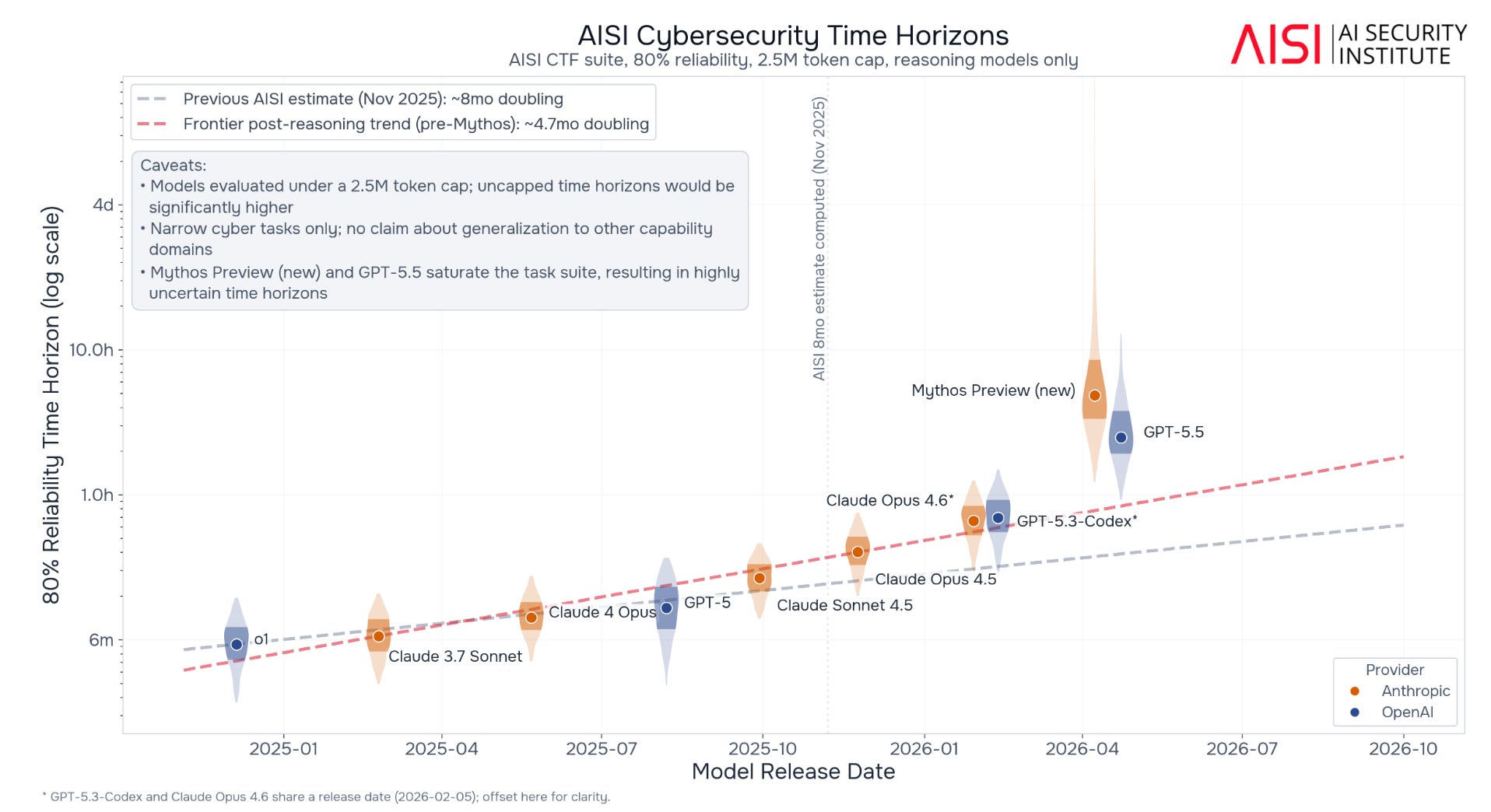
But zoomed out and viewed within the broader context of AI progress, nothing has happened that should be too surprising. AI capabilities have been advancing rapidly for years, with the length of coding tasks (as measured by how long it takes a skilled human to do them) doubling every few months. The rate of progress currently shows no signs of slowing down. In fact, just last week the UK’s AI Security Institute published work indicating that this already exponential trend could be accelerating even faster in the domain of cybersecurity.
It was only a matter of time before we saw AIs with these levels of capability, but this is only the tip of the iceberg. The goal of AI companies like Anthropic and OpenAI isn’t to automate cybersecurity. They’re explicitly aiming to develop superintelligent AI — AI vastly smarter than humans — and they’re trying to get there as fast as possible.
Experts and insiders, including the CEOs of these companies, believe they could get there within just the next 5 years, but worryingly, they don’t have a credible plan to control AI this powerful. This is why leading AI scientists, Nobel Prize winners, and countless more experts have been warning that the development of superintelligent AI poses a risk of human extinction. Last year, a huge coalition of experts and leaders that included the two most-cited living scientists in the world, Yoshua Bengio and Geoffrey Hinton, known as godfathers of AI, called for a ban on the development of the technology — an initiative we’re proud to have helped with.
It’s crucial that as political leaders contend with the risks of AI, they understand that Mythos-level AI hacking is only today’s problem. In the near future, we could be faced with much more dangerous systems that have the potential to cause human extinction.
The only known method to prevent the threat posed by superintelligence is to prohibit its development. We think this should be done both domestically by countries and agreed internationally.
Cooperation
One issue that threatens to compound the risk posed by advanced AI systems is the competitive dynamic that exists between nations. With policymakers largely unaware of the risk of extinction posed by superintelligence, there are incentives to accelerate AI development towards ever more powerful systems, potentially cutting corners on ensuring they’re actually safe and that we won’t lose control of them.
Ultimately, it doesn’t really matter where superintelligence is built. Wherever it is built, humanity is faced with a threat of extinction. While the rivalries that exist between countries are real, there is also a common interest in preventing this threat.
For this reason, it’s important for leaders of different countries to talk to each other and try to see where there’s common ground for dealing with the risks of AI.
Last week, President Trump was in Beijing for talks with China’s President Xi, and AI was on the agenda. We don’t know much about what was discussed, but President Trump did say afterwards that they discussed AI guardrails and that they’re probably going to work together on it.
After the meeting, US Treasury Secretary Scott Bessent said: “The two AI superpowers are going to start talking. We’re going to set up a protocol in terms of how do we go forward with best practices for AI to make sure nonstate actors don’t get a hold of these models”.
AI News Digest
The Kill-switch Amendment
On Saturday, there was a great article published in the Telegraph on Alex Sobel MP’s AI kill-switch amendment.
In the article, Alex Sobel compares uncontrolled superintelligence to a nuclear strike: “This is not only a paradigm shift for cybersecurity, but for the national security risks that AI poses for our critical infrastructure. And the UK is nowhere near ready to respond ... Co-ordinated cyberattacks on our critical infrastructure pose a serious threat, and superintelligent AI operating beyond human control could rival a nuclear strike in the harm it inflicts. The gap between these threats and our preparedness is untenable.”
We’re proud to have worked with Alex on the amendment and to have him as one of the 100+ UK parliamentary supporters of our campaign!
Pope Leo’s Encyclical
Pope Leo is set to present his first encyclical on AI, a major teaching document on the subject and its challenges. It will reportedly be titled “Magnifica humanitas” (Magnificent humanity) and will focus on the protection of the human person.
AI Disproves a Central Conjecture in Discrete Geometry
OpenAI reports that an internal AI at the company has developed a proof concerning a well-known mathematical conjecture which has eluded mathematicians for decades. Interestingly, the conjecture was generally thought likely to be true, but the AI proved that it was, in fact, false.
Earlier this year, we wrote about how AI was already starting to solve open mathematical problems.
Anthropic’s Jack Clark
At a lecture given at Oxford this week, Anthropic co-founder Jack Clark has warned that there are plausible scenarios in which AI has a chance of “killing everyone on the planet”, stressing that this risk hasn’t gone away.
Nevertheless, his company is racing to develop artificial superintelligence — which is what poses this threat. This week, it was announced that Anthropic hired Andrej Karpathy, one of OpenAI’s co-founders, to build an internal team focused on recursive self-improvement. Getting AIs to recursively self-improve is considered to be an exceptionally dangerous method to advance AI capabilities.
Karpathy recently said in an interview that he saw society reshaping so that humans serve the needs of AI, rather than those of humans.
Take Action
To close where we started, if you do one thing this week, please make it this!
Just this morning, the UK parliament selected 20 MPs to introduce a bill of their choosing for debate. This is an incredible opportunity for an MP to introduce ControlAI’s bill to prohibit superintelligent AI in the UK. These MPs are weighing their options right now and need to hear from YOU about why prohibiting superintelligent AI should be at the top of their list.
We just built a new version of the MP contact tool specifically to help you contact all of these MPs. Email them here.
This would be the first bill introduced anywhere in the world to prohibit superintelligent AI, bringing us one huge step closer to a world safe from superintelligence.
Sir Desmond Swayne MP, who already supports our campaign, was the #1 MP selected, meaning the bill he proposes will certainly be debated! If you can only send one email, contact him.
If you don’t live in the UK, you can still help by talking about the bill on social media and encouraging your friends in the UK to contact these MPs with our tool!
BAN AI COMPLETELY! I NEVER WANTED AI!
Very good question! Probably not!